
1. Introduction
Ethylene Vinyl Acetate (EVA) is a versatile copolymer made from ethylene and vinyl acetate monomers. It combines the flexibility and toughness of rubber with the processability of thermoplastics, making it one of the most widely used materials across multiple industries.
Thanks to its transparency, elasticity, toughness, and chemical resistance, EVA is often described as a “soft plastic with rubber-like properties.” It is used in everything from footwear soles and packaging films to solar panels and hot-melt adhesives.
2. What Is EVA Made Of?
EVA is produced by polymerizing ethylene and vinyl acetate (VA) together in varying proportions.
The vinyl acetate content typically ranges from 5% to 40%, and this ratio determines its physical characteristics:
- Low VA content (4–10%): The polymer behaves more like polyethylene—rigid and stronger.
- Medium VA content (11–20%): Offers good flexibility and toughness, often used in films and cables.
- High VA content (above 25%): Provides excellent softness, elasticity, and transparency—common in footwear, adhesives, and solar encapsulation sheets.
The balance between flexibility and strength makes EVA an extremely adaptable material for diverse production needs.
3. Key Characteristics of EVA
EVA stands out for its unique combination of elasticity, clarity, and chemical stability. Below are its main properties:
✅ Flexibility and Softness
EVA remains soft and flexible even at low temperatures, unlike rigid plastics such as PVC or HDPE.
✅ Excellent Transparency
It offers high optical clarity, making it suitable for transparent films and encapsulation applications.
✅ Strong Impact and Crack Resistance
EVA absorbs shocks and resists stress cracking, ideal for protective and cushioning applications.
✅ Lightweight and Resilient
Its rubber-like structure gives it excellent rebound performance, which is why it’s often used in athletic shoes and foam products.
✅ Good Chemical and UV Resistance
EVA resists many acids, oils, and alkalis, and can be stabilized for outdoor use with UV additives.
✅ Thermal Processability
It can be easily processed through injection molding, extrusion, or compression molding, offering manufacturers flexibility and efficiency.
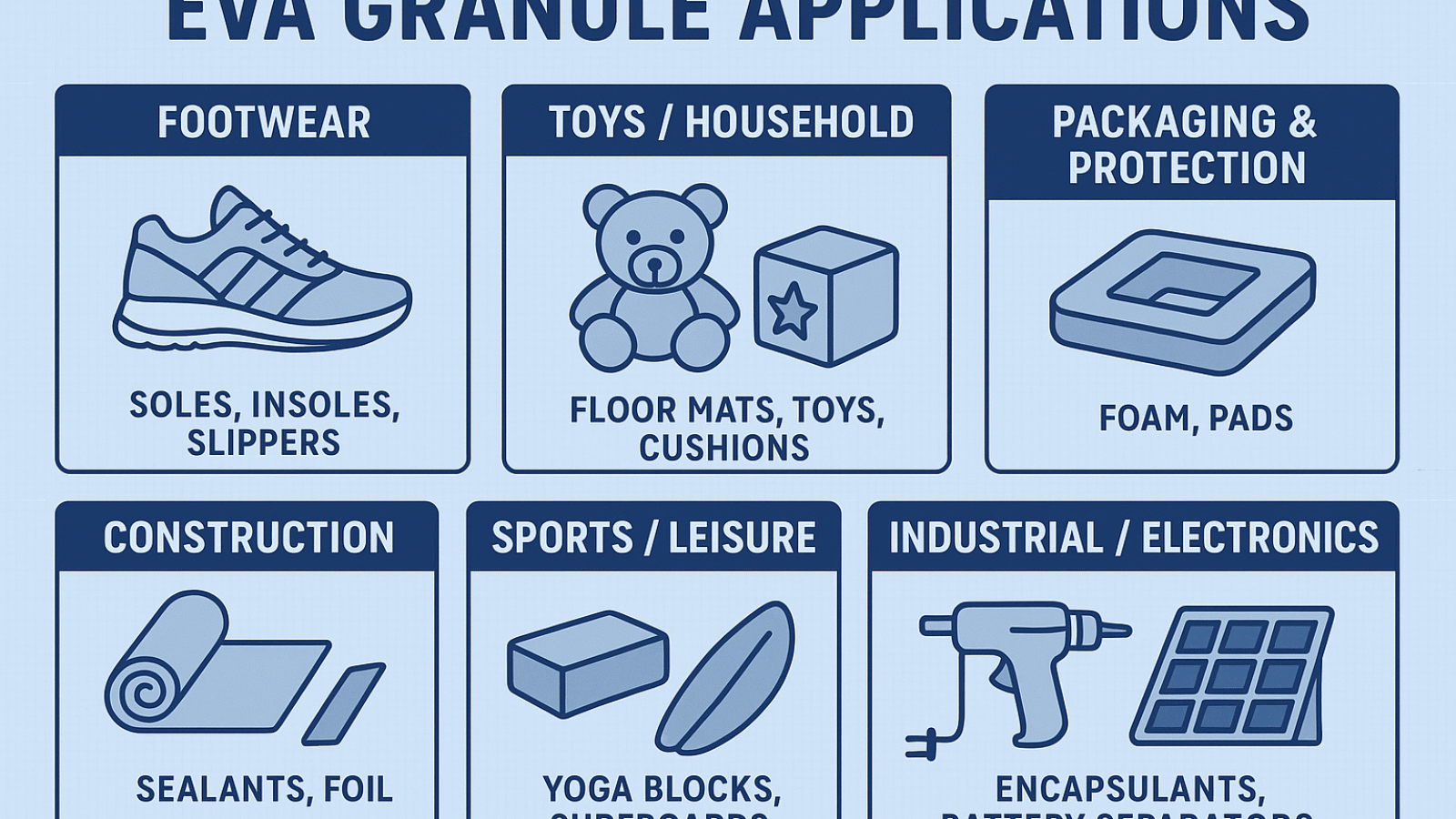
4. Main Applications of EVA
Thanks to its unique combination of properties, EVA is used across a wide range of industries:
🏃 1. Footwear Industry
EVA foam is widely used in shoe soles, sports footwear, and sandals. Its lightweight, cushioning, and flexibility make it ideal for comfort and shock absorption.
🌞 2. Solar Energy
In solar panels, EVA acts as an encapsulation layer between the glass and photovoltaic cells. It provides excellent transparency, adhesion, and weather resistance—protecting solar cells for over 25 years.
📦 3. Packaging Films
EVA is used in stretch and shrink films, lamination films, and food packaging. Its flexibility, clarity, and sealing strength help maintain product integrity and freshness.
🧴 4. Adhesives
EVA-based hot-melt adhesives (HMA) are popular in packaging, bookbinding, woodworking, and hygiene products due to their strong bonding performance, quick setting, and low odor.
🔌 5. Wires and Cables
EVA serves as an insulating and jacketing material in electrical cables, offering flexibility, weather resistance, and excellent dielectric properties.
🧸 6. Toys and Consumer Goods
Its non-toxic nature, softness, and durability make EVA ideal for toys, yoga mats, play mats, and foam rollers.
🧱 7. Construction and Automotive
Used as sound and vibration damping materials, sealing layers, and interior foams. EVA contributes to noise reduction, cushioning, and energy absorption in cars and buildings.
5. Environmental Aspects
EVA is non-toxic, BPA-free, and phthalate-free, making it safer for consumer and medical applications.
While not biodegradable, EVA is recyclable and can be reprocessed into new products or used as a filler in compounding materials. New developments are also focusing on bio-based EVA derived from renewable sources like sugarcane, further enhancing sustainability.
6. Conclusion
Ethylene Vinyl Acetate (EVA) is a flexible, durable, and multi-functional polymer that bridges the gap between rubber and plastic.
Its balance of elasticity, transparency, and strength allows it to serve in industries as diverse as footwear, packaging, solar energy, and adhesives. As technology advances, EVA continues to play an important role in sustainable materials and next-generation manufacturing.
SEO Keywords:
Ethylene Vinyl Acetate, EVA copolymer, EVA material, EVA applications, EVA properties, EVA foam, solar encapsulation EVA, hot melt adhesive EVA, EVA film, EVA in footwear
Add a Comment