
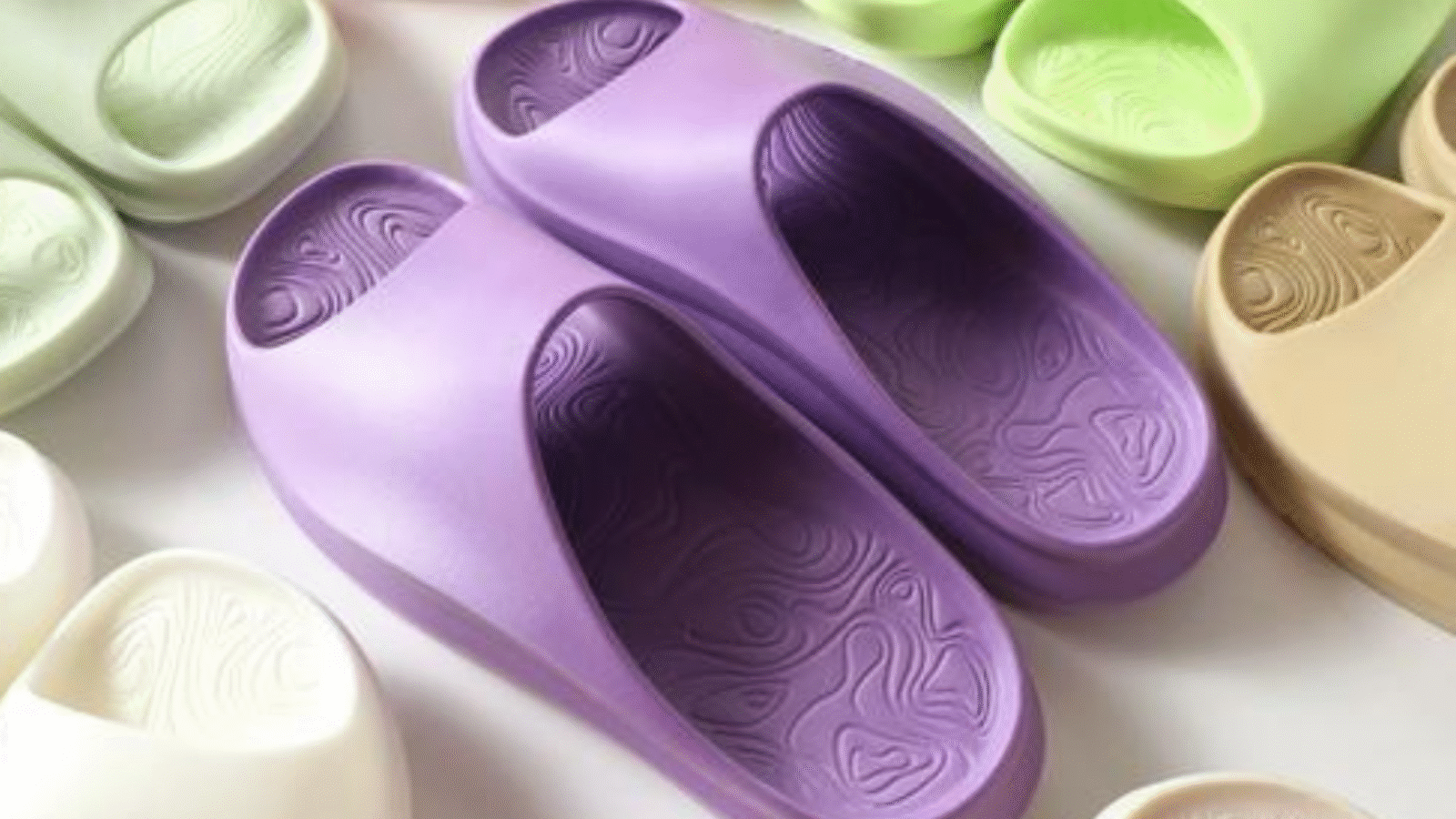
In modern footwear production, Ethylene Vinyl Acetate (EVA) has established itself as a preferred material for midsoles, outsoles, and cushioning components due to its lightweight, flexible, and shock-absorbing properties. To further enhance EVA’s performance and reduce production costs, calcium carbonate (CaCO₃) has emerged as one of the most widely used fillers in the footwear industry.
What is Calcium Carbonate?
Calcium carbonate is a naturally occurring mineral that appears in the form of fine powder. In polymer processing, it is used as a functional filler to improve mechanical properties, thermal stability, and cost efficiency. Its high whiteness, fine particle size, and chemical inertness make it ideal for EVA formulations used in footwear manufacturing.
Enhancing EVA Properties with Calcium Carbonate
- Improved Mechanical Strength
Calcium carbonate reinforces EVA by increasing its hardness and tensile strength. This is particularly beneficial for midsoles and outsoles that must maintain shape and support over prolonged use. By carefully controlling the particle size and content, manufacturers can achieve a balance between cushioning and structural integrity. - Better Foam Control and Density
In EVA foam processing, calcium carbonate acts as a nucleating agent that regulates cell formation. Uniform foam cells result in consistent density, smoother surfaces, and reduced material defects. This ensures EVA soles are not only comfortable but also visually appealing and durable. - Thermal and Dimensional Stability
EVA shoes often undergo processes involving heat, such as molding or lamination. Calcium carbonate enhances thermal stability, allowing the material to withstand elevated temperatures without deformation. Additionally, it contributes to dimensional stability, reducing shrinkage and warping in finished products. - Cost Efficiency
Calcium carbonate is an economical filler that can partially replace EVA resin without compromising performance. By reducing the polymer content, manufacturers lower production costs while maintaining or even improving certain mechanical and processing properties, making it an ideal solution for large-scale footwear production. - Enhanced Surface Quality
For EVA soles requiring textures, patterns, or printed designs, calcium carbonate improves surface smoothness. Its fine particles fill micro-voids in the foam structure, providing better printability and a more uniform appearance. This is particularly valuable for fashion sneakers and high-performance sports shoes.
Applications in Footwear
Calcium carbonate-filled EVA is commonly used in athletic shoes, casual sneakers, sandals, and safety footwear. It is especially effective in midsoles and outsoles, where both cushioning and structural support are critical. The combination of improved hardness, foam uniformity, and thermal resistance ensures that EVA shoes maintain comfort and durability throughout their lifecycle.
Conclusion
Calcium carbonate is a key additive that enhances the versatility and cost-effectiveness of EVA in footwear manufacturing. By improving mechanical properties, foam quality, thermal resistance, and surface finish, it allows manufacturers to produce high-quality, durable, and visually appealing shoes. For footwear companies aiming to optimize EVA formulations, calcium carbonate is a reliable and efficient solution that balances performance with production economics.
Keywords: Calcium carbonate, EVA footwear, EVA soles, polymer filler, EVA foam, shoe manufacturing, EVA compounding, footwear materials
Add a Comment