
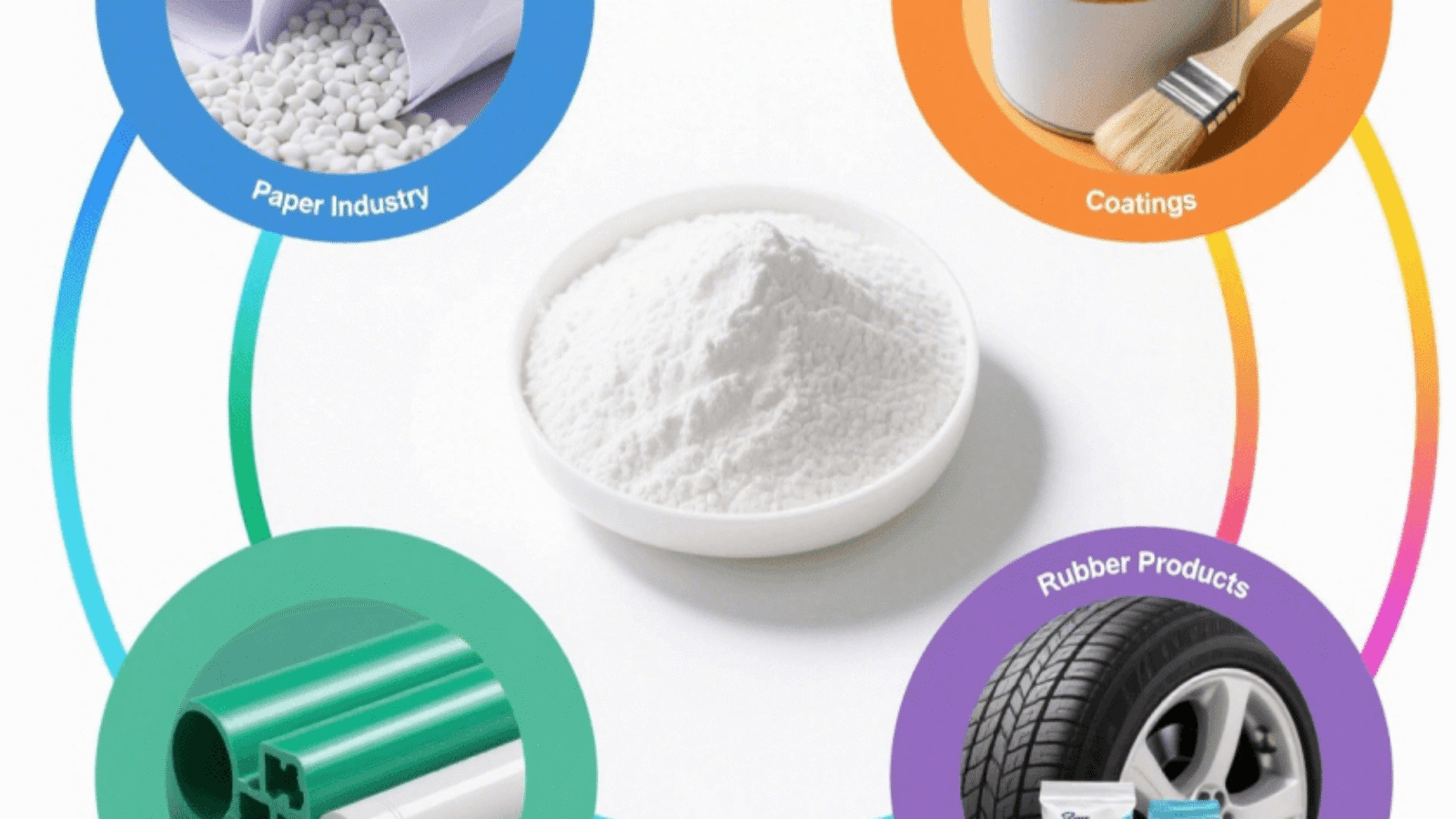
Calcium carbonate (CaCO₃) is one of the most widely used industrial minerals due to its abundance, stable chemical properties, and cost-effectiveness. Available in both ground (GCC) and precipitated (PCC) forms, calcium carbonate offers excellent whiteness, controlled particle size, and multifunctional performance. These features make it an essential raw material across plastics, coatings, construction, paper, rubber, and many other manufacturing sectors.
1. Calcium Carbonate in Plastics and Polymers
One of the largest application markets for calcium carbonate is the plastics industry. It is commonly used in PP, PE, PVC, and masterbatch production to improve stiffness, dimensional stability, and impact resistance. Fine-particle calcium carbonate helps reduce shrinkage, enhances surface smoothness, and improves the heat resistance of plastic parts. For manufacturers, CaCO₃ also provides a significant cost advantage by reducing the use of resin.
Key benefits in plastics include:
- Better rigidity and mechanical strength
- Improved thermal stability
- Enhanced surface finish
- Reduced production costs
2. Applications in Rubber and Elastomers
In rubber products such as tires, hoses, belts, and sealing materials, calcium carbonate acts as a reinforcing filler. It improves tensile strength, abrasion resistance, and elasticity. Because of its chemical stability and low oil absorption, CaCO₃ helps maintain consistent compound viscosity during rubber processing.
3. Essential Additive in Paints and Coatings
Calcium carbonate is a critical functional extender in architectural coatings, industrial paints, primers, and powder coatings. Its high whiteness and opacity help optimize pigment use while improving brightness and coverage. CaCO₃ also enhances the rheology and anti-settling performance of coatings, contributing to smoother application and durable film properties.
Advantages in coatings:
- Excellent whiteness and gloss control
- Improved scrub resistance
- Better dispersion stability
- Cost-effective pigment replacement
4. Major Component in the Paper Industry
In paper production, calcium carbonate is used as both a filler and a coating pigment. It improves paper brightness, opacity, smoothness, and printability. Because CaCO₃ is alkaline, it also enhances the longevity of paper by providing acid-free properties, which is essential for books and archival materials.
5. Key Material in Construction and Building
Construction is another major field where calcium carbonate is widely applied. It is used in cement, concrete blocks, adhesives, sealants, and dry-mix mortar. Ground calcium carbonate enhances workability, improves durability, and reduces shrinkage in construction materials. In PVC construction profiles and pipes, CaCO₃ also contributes to hardness and UV stability.
6. Uses in Agriculture and Environmental Applications
Agriculture relies on calcium carbonate as a soil conditioner to neutralize acidity and provide essential calcium for plant growth. In environmental treatment, CaCO₃ is used for flue gas desulfurization, wastewater neutralization, and heavy-metal removal thanks to its buffering capability.
Conclusion
Calcium carbonate’s versatility, performance advantages, and cost efficiency make it indispensable across modern industries. Whether used to reinforce plastics, brighten coatings, strengthen construction materials, or improve soil health, CaCO₃ continues to play a crucial role in global manufacturing and sustainable production. With ongoing advancements in particle engineering and surface modification, its industrial value will only grow in the years ahead.
Add a Comment