
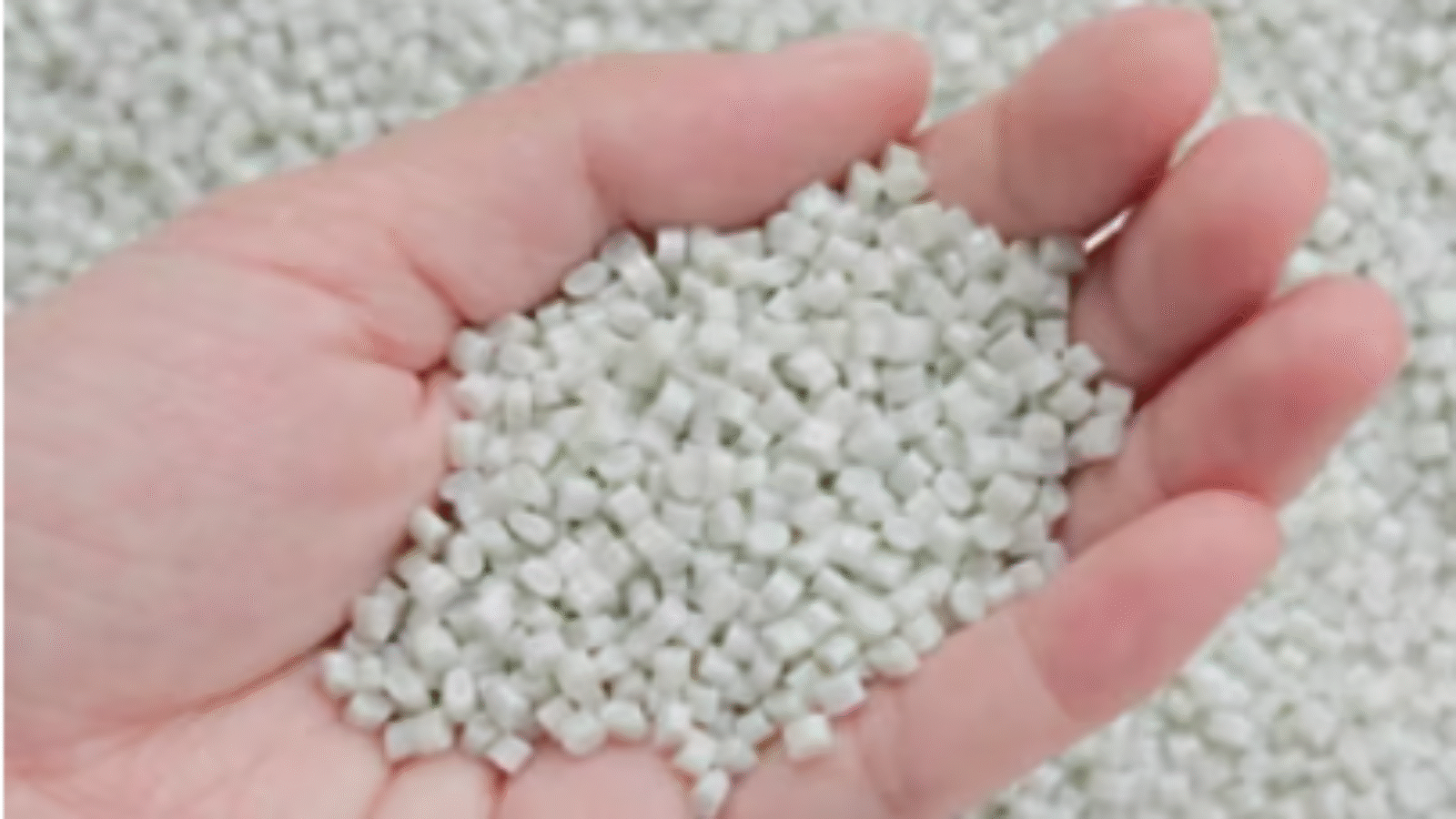
Inorganic fillers are essential additives in the footwear industry, especially in materials like EVA, rubber, PU, and PVC. These fillers not only reduce production costs but also improve hardness, flexibility, compression set, and appearance of shoe soles and midsoles. By selecting suitable fillers, manufacturers can optimize both performance and economy for different footwear applications such as sports shoes, sandals, and safety boots.
1. Calcium Carbonate (CaCO₃)
Calcium carbonate is the most widely used inorganic filler in shoe materials. It provides an ideal balance between cost and performance. In EVA foaming, calcium carbonate improves the foam’s density uniformity, surface smoothness, and dimensional stability. In rubber soles, it enhances hardness and wear resistance while keeping good elasticity.
Key advantages:
- Reduces production cost
- Improves hardness and shape retention
- Enhances foam cell uniformity in EVA
Applications: EVA soles, rubber midsoles, PVC sandals, and insoles.
Typical loading: 10–40% by weight.
2. Talc (Mg₃Si₄O₁₀(OH)₂)
Talc is a soft, lamellar filler that enhances the flowability and mold release of EVA and rubber compounds. It also provides a smooth surface and a pleasant touch. In shoe manufacturing, talc helps reduce material shrinkage and improves the dimensional accuracy of molded parts.
Benefits:
- Improves processability and demolding
- Provides smooth, fine texture
- Enhances heat resistance and rigidity
Applications: EVA midsoles, foam sheets, and rubber outsoles.
3. Barium Sulfate (BaSO₄)
Barium sulfate is a high-density white filler used to increase weight, opacity, and brightness of shoe materials. It gives a more stable feel underfoot and provides good chemical and weather resistance. In high-end footwear, it’s used for soles requiring higher density and better appearance.
Advantages:
- High density and whiteness
- Chemical and UV stability
- Improves wear and scratch resistance
Applications: PVC soles, PU outsoles, specialty rubber footwear.
4. Kaolin (China Clay, Al₂Si₂O₅(OH)₄)
Kaolin is commonly used in rubber compounds for shoes to enhance stiffness, improve tear resistance, and reduce shrinkage. It also acts as a reinforcing agent and helps control the viscosity of EVA foaming materials.
Benefits:
- Improves tear and tensile strength
- Provides smooth appearance and dimensional stability
- Good dispersion and process control
Applications: Rubber soles, EVA foams, and shoe lining materials.
5. Silica (SiO₂)
Silica is a reinforcing filler that significantly improves the abrasion resistance and hardness of rubber and EVA soles. It’s especially suitable for sports shoes and industrial footwear, where durability and grip are essential.
Key features:
- Enhances wear resistance and anti-slip properties
- Improves tear strength and flexibility
- Excellent for high-performance rubber compounds
Applications: Sports shoe soles, safety shoes, high-end EVA foams.
6. Aluminum Hydroxide (ATH) and Magnesium Hydroxide (MH)
Both ATH and MH are used as flame retardant fillers in EVA and PU foams for safety footwear. They release water when heated, absorbing heat and reducing smoke generation. These eco-friendly fillers are ideal for halogen-free formulations.
Advantages:
- Effective flame retardancy
- Non-toxic and environmentally friendly
- Smoke suppression and improved thermal stability
Applications: Work boots, safety shoes, EVA foam sheets for flame-retardant soles.
7. Zinc Oxide (ZnO)
Zinc oxide is an important additive in rubber vulcanization and acts as both an activator and reinforcing filler. It improves the cross-linking efficiency and enhances mechanical strength, elasticity, and resistance to aging.
Benefits:
- Promotes uniform vulcanization
- Improves tensile strength and resilience
- Provides antimicrobial and anti-odor properties
Applications: Rubber soles, heel pads, and shoe insoles.
8. Silicate Fillers (Wollastonite, Mica)
Silicate fillers like wollastonite and mica are used in engineering shoe materials that require high strength, dimensional stability, and thermal performance. These fillers enhance the rigidity and durability of structural shoe parts such as midsoles and heel counters.
Advantages:
- Reinforcement and shape stability
- Heat and chemical resistance
- Lightweight with excellent surface finish
Applications: Structural components in high-performance sports and safety footwear.
Conclusion
Inorganic fillers are indispensable for modern footwear materials. From cost-saving fillers like calcium carbonate to functional fillers like silica and ATH, each serves a unique purpose in balancing performance, safety, and aesthetics. As consumer demand for lightweight, comfortable, and eco-friendly shoes continues to grow, the use of optimized filler combinations will remain a key factor in next-generation shoe material innovation.
Add a Comment